Bethany Allen’s Beijing Rules reveals the strategy and silence behind China’s rise
When historians write the story of China’s rise to superpower status, the 2020 coronavirus pandemic will likely warrant at least one chapter. So argues Bethany Allen in her timely and unsettling book Beijing Rules: China’s Quest for Global Influence (2023). In Allen’s telling, the pandemic did more than expose weaknesses in the West. It turbocharged China’s rise, elevating its authoritarian model, empowering its economy, and sharpening the tools it uses to extend its reach abroad.
“The Chinese government punished people, organisations, and countries for repeating the basic scientific fact that the pandemic had originated in China,” she writes.
As Covid-19 spread across the globe, Western democracies faltered, beset by political indecision and digital disinformation. In contrast, China’s rigid state apparatus mobilised swiftly. With tight control over its tech sector and media, the Communist Party managed the crisis with a clarity and discipline democracies simply could not match. The result: China emerged from the global crisis not only as a survivor, but as a contender for global leadership.
Western companies had already made China the linchpin of the global supply chain. That dependence now gave Beijing enormous leverage. China’s diaspora quickly mobilised to send supplies home, while domestic factories ramped up exports of critical goods such as masks, gloves, and pharmaceuticals. Research institutions that once lagged behind became formidable competitors in the race for vaccines. And when they succeeded, China donated jabs abroad, even as Western nations hoarded theirs.
The politics of economic power
Allen opens her account with a concept she calls “economic statecraft,” Beijing’s strategy of using market access as a lever of control. In this, China’s economy mirrors its politics: authoritarian, centralised, and relentlessly strategic.
“China’s leaders have increasingly used market access and denial to shape state behaviour, security outcomes, multilateral institutions, and performative allegiances on the global stage,” she writes.
When Covid-19 first broke out, China’s instinct was to conceal it. But by April 2020, the virus had reached dozens of countries, infecting over 2.5 million people and killing at least 177,500. The lid could no longer hold. One of China’s neighbours, Australia, publicly called for an independent investigation into the virus’s origins. Then–Prime Minister Scott Morrison’s request infuriated Beijing, which preferred silence. China responded swiftly and punitively.
Within weeks, China banned meat imports from Australia’s four largest abattoirs. It imposed an 80% tariff on Australian barley. But it was wine that bore the brunt. China, once the top destination for Australian wine, responded with crushing duties, slashing exports from $240 million to just $9 million. In total, the trade war cost Australia $9 billion, nearly crippling its export economy.
Playing hardball
Is China alone in weaponising economic policy? Allen argues not. The United States, she notes, has long used financial sanctions to protect the global order, counter terrorism, and punish corruption. But that high ground is eroding. Under Trump, the U.S. is now wielding tariffs with increasing bluntness. Just recently, Trump lifted a 50% tariff on the European Union after what he called a “nice call” with Commission President Ursula von der Leyen.
Still, only China and the U.S. have economies large enough to wield coercive diplomacy on this scale. What separates them, Allen suggests, is not morality but method. American tariffs under Trump are often impulsive, announced via tweet and reversed just as quickly, a strategy Wall Street traders mockingly nicknamed TACO (Trump Always Chickens Out). China’s approach, by contrast, is deliberate and devastatingly effective.
For example, no major Hollywood film critical of China has been released since the 1990s. Trump may threaten to ban foreign movies, but Beijing’s censorship carries real bite. In 2010, after the Nobel Peace Prize was awarded to Chinese dissident Liu Xiaobo, China halted imports of Norwegian salmon. When Western brands like Nike and H&M raised concerns about forced labour in Xinjiang, they vanished from Chinese e-commerce platforms and, in some cases, from digital maps altogether.
Technology firms are particularly exposed. Giants like Facebook and Google declined to play by Beijing’s rules and were shown the door. Others, including LinkedIn and Zoom, have proved more pliant, going so far as to censor users outside China to maintain access to the mainland market. The defence is a familiar one: companies, we are told, must abide by the laws of the countries in which they operate. On paper, at least, this is a difficult point to contest.
Beijing’s red lines are clear and uncompromising: Tibet, Taiwan, the South China Sea, Xinjiang, and even the deployment of THAAD missile systems in South Korea. Criticise them, and consequences will follow.
Precision pressure
What makes China’s economic tactics especially potent is their precision. Australia’s economy is heavily reliant on iron ore, 82% of which goes to China. Yet iron ore was conspicuously absent from Beijing’s sanctions. The reason? China depends on it. It makes up 60% of the country’s iron imports, and cannot be easily replaced.
This is not brute-force diplomacy. It is pressure applied with surgical skill.
Recent developments only reinforce Allen’s argument. Though Trump’s tariffs dominate headlines, it was China that refined the use of economic punishment into an art. The trade war that erupted in 2018, after Trump levied $34 billion in tariffs on Chinese goods, soon devolved into tit-for-tat chaos, driven more by ego than grand strategy.
Shadows abroad
Allen’s reporting grows darker when she turns to China’s expanding global footprint. In one chilling account, she recounts the case of Christine Fang, a Chinese student in California who allegedly operated as a spy, cultivating ties with rising U.S. politicians, donating to campaigns, and even engaging in romantic relationships. For some, this is a cautionary tale. For others, it’s a pretext for restricting student visas and academic exchanges. On May 29th, the U.S. announced it will revoke visas for all Chinese students.
But the book’s central claim endures: in opening itself to China, America also made itself vulnerable to manipulation. China, Allen argues, observes no such ethical boundaries as the United States. Where Washington steers clear of using journalists or missionaries as spies, Beijing displays no such hesitation.
Sister-city agreements between American and Chinese municipalities may have seemed innocuous, but Beijing used them to quietly advance its agenda. Likewise, Chinese cultural associations abroad often served a dual purpose. They promoted cultural exchange on the surface while hosting state agents tasked with monitoring dissidents, recruiting allies, and extending Beijing’s soft power.
“The best defence against such activity isn’t to prosecute it to death but, rather, to foster widespread awareness throughout society that such activity is taking place,” she writes.
At times, Allen’s portrait edges close to the conspiratorial, suggesting that few Chinese abroad are entirely beyond the Party’s reach. But this, she contends, is the nature of China’s authoritarian model. It is totalising, methodical, and unnervingly effective. In the West, such control feels almost fictional. In Beijing, it is simply policy.
The end of the liberal order?
Allen’s book is most compelling when she moves beyond the US-China rivalry and examines how Beijing is extending its influence in other countries. She finds unlikely models for how to respond, including Australia and, more surprisingly, the World Health Organisation.
Australia’s pushback began not with Scott Morrison but with Malcolm Turnbull, who led the country from 2015 to 2018. By that time, China had already started refining its tactics by cultivating influence at the local level, embedding operatives, and exploiting gaps in governance. In 2015, the Chinese Landbridge Group secured a 99-year lease on Port Darwin, an ageing wharf in northern Australia, by negotiating directly with a local government and bypassing federal oversight. It later emerged that Landbridge had ties to the Chinese military.
The following year, Sam Dastyari, a senator from New South Wales, publicly endorsed China’s position on the South China Sea. He was later found to have accepted donations from Chinese billionaire Huang Xiangmo, a permanent resident whose citizenship application he had personally supported. Dastyari also tipped Huang off after Australia’s intelligence agency began monitoring him. These incidents exposed the depth of Beijing’s political influence in Australia.
In response, Turnbull appointed journalist John Garnaut, a seasoned China correspondent, to assess the threat. Turnbull began speaking openly of “covert, coercive or corrupting” foreign interference. Garnaut led a classified inquiry into the Chinese Communist Party’s influence in Australia. His findings would later help shape U.S. foreign policy under President Trump’s first term, laying the foundation for the trade war and a shift in focus from counterterrorism to a new long-term rival.
The WHO took a different approach. Director-General Tedros Adhanom Ghebreyesus brought experience as Ethiopia’s former foreign minister, a role that required diplomatic caution. At first, Tedros was careful not to antagonise China, reflecting a wider trend across Africa where reliance on Chinese loans has led many governments to avoid criticism of Beijing’s core interests: Taiwan, Hong Kong, Xinjiang and its human rights record.
Yet deference only went so far. Despite his initial compliance, China delayed sharing crucial data on the origins of Covid-19, obstructed the WHO’s research efforts, and eventually left Tedros with no choice but to push back. His defiance became one of the rare instances of institutional resistance to China’s growing influence.
In the end, Beijing Rules becomes less a book about China and more a study of America’s waning authority. Allen outlines a world now caught between two rival systems: the fading promises of Western neoliberalism and the rising allure of China’s “neo-authoritarianism”, a term coined by CCP theorist Xiao Gongqin.
Allen argues, convincingly, that neoliberalism, the belief that free markets left to their own devices will deliver prosperity, has failed. In its place, corporations pursuing profit without accountability have eroded the state and empowered a new billionaire class. Government has been hollowed out, its role diminished to theatre.
“Excessive government intervention in the economy was both a symptom of political unfreedom and, in and of itself, an impingement on freedom; while sweeping away government involvement in economic decisions would pave the way for political liberty,” she writes.
Though Allen doesn’t state it directly, the implication is clear: China’s authoritarian model is, in many ways, working. Around the world, citizens look not to Washington but to Singapore, Dubai, even Beijing, for a vision of governance that delivers results. Where democracy offers compromise, authoritarianism promises efficiency.
In 2024, American TV host Tucker Carlson returned from Moscow praising the Russian subway. In the UK, Reform Party deputy leader Richard Tice spoke admiringly of Dubai’s tough-on-crime model. And according to the World Bank, China has accounted for more than 70% of global poverty reduction since 1970, a result of policies inspired by Singapore’s Lee Kuan Yew.
By contrast, neoliberalism has left devastation in its wake. From Vietnam to Iraq, Afghanistan to Libya, American interventions have collapsed into violence and disorder. At home, infrastructure is crumbling, inequality is rising, and political discourse is reduced to soundbites. Even Russia, which once flirted with free markets, has returned to strongman rule.
Now America itself appears tempted. Trump has shown little interest in democratic norms or compromise. Where other autocrats build infrastructure, he promises spectacle, a golden dome. Rule by decree is no longer foreign, it is creeping toward the White House.
Allen’s prescriptions for reform are uneven. She calls for government oversight of social media and curbs on foreign lobbying, proposals that risk tipping into authoritarianism themselves. But the urgency of her warning cannot be dismissed. If the US retreats and China fills the void, who will champion freedom, not as a slogan but as a governing system?
For now, there is no clear answer. The old world is fading, and its replacement has yet to emerge. But Beijing Rules shows how China rose quietly while America was consumed by its foreign misadventures. The silent giant has awakened. The question now is whether it will remake the world or break it.
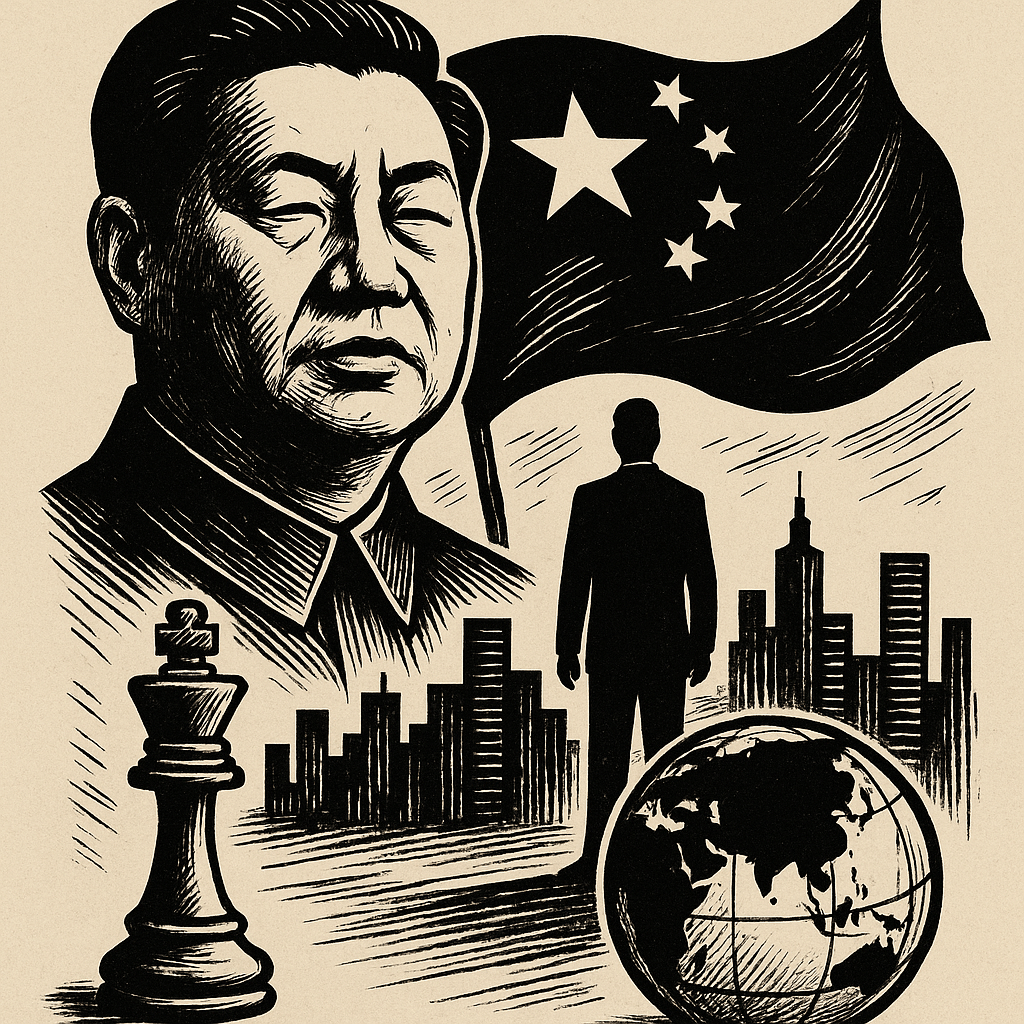
This article’s illustration was generated using ChatGPT, an artificial-intelligence tool by OpenAI.
 Wayfarer