
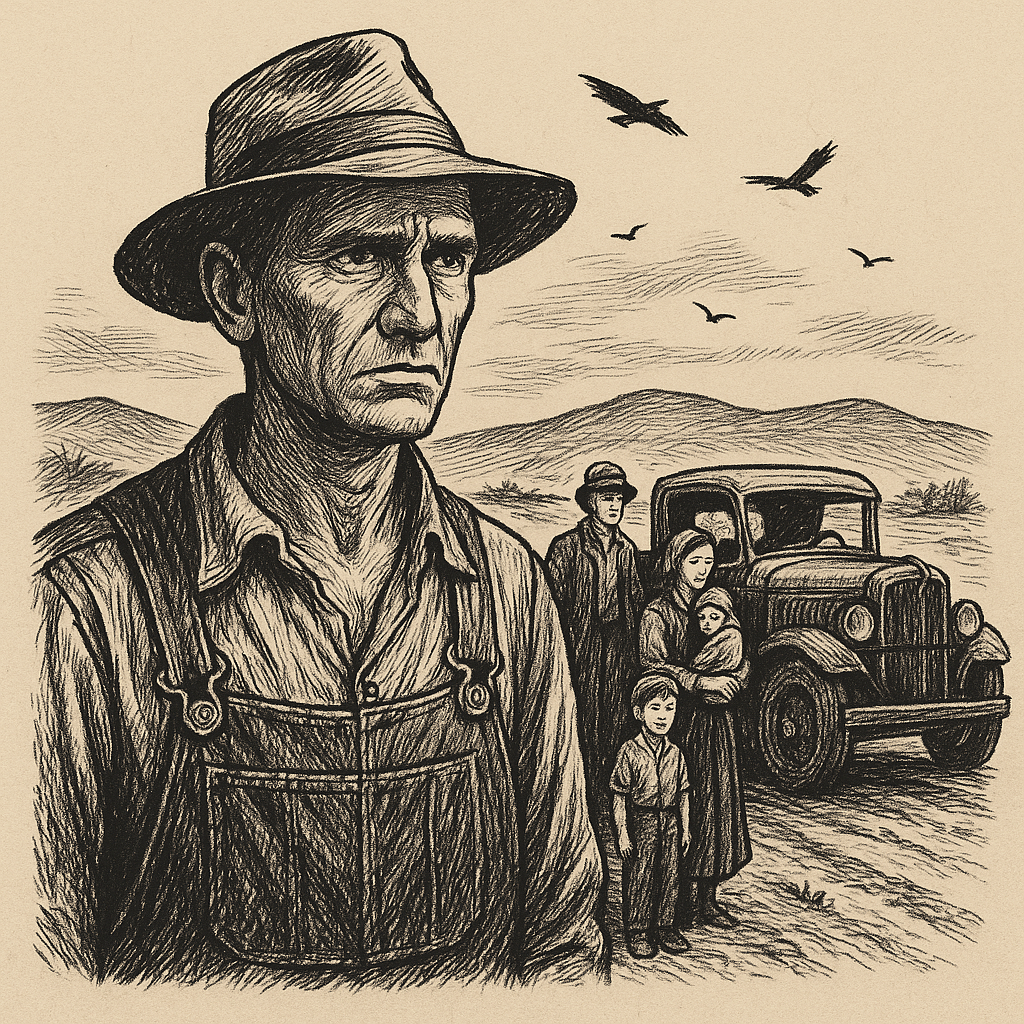
As America edges toward authoritarianism, I picked up John Steinbeck’s The Grapes of Wrath again.
Written in 1938 as a chronicle of the Great Depression, the novel now reads like a grim prophecy. In hard, deliberate prose, Steinbeck records a fraying country: men without purpose, the poor simmering with rage, families torn apart. Policemen are too quick to assert authority, and a generation of drifters is shunned by the very society that feeds on their labour. Most striking is Steinbeck’s description of the American Dream as myth, a hollow promise handed down from generation to generation by force of habit and spoken of grandly, but never truly attained.
I read the novel as Trump’s second term crossed its hundred-day mark. In that time, the administration revoked visas for nearly 1,700 students; dismantled the U.S. Agency for International Development, and slapped tariffs on the world, only to lift them and turn with wounded pride against China, the lone holdout. Tech billionaire Elon Musk offered the era’s epitaph: “The fundamental weakness of Western civilisation is empathy.” Each day brings a headline labelled “unprecedented.” In the scramble to make sense of the noise, we lose our grip on reality.
Fiction Against Forgetting
Literature, with its indifference to urgency, helps restore clarity. The Grapes of Wrath reminds us that America’s scorn for the dispossessed is not new. Only the target changes. Before the arrival of the Mexicans, it was the Italians, the Irish, the Chinese. Seldom has a group of refugees been welcomed with open arms. Sometimes America even turned against its own citizens.
The novel’s plot is deceptively simple: a family driven from its land goes in search of a home. But beneath that premise lies a harsher truth. When the Great Depression struck, the price of wheat and cotton plummeted. Farmers in the southern U.S. could no longer pay their debts. The banks took their land—land they had worked for generations. So the dispossessed turned west, clinging to the hope of work. Most came from Oklahoma, Texas, and Kansas.
But they found no welcome in California. Fearing an influx, the state shut its doors. Police patrolled the borders. Towns erected roadblocks. Armed locals turned migrants away. Yet the state still needed cheap labour. So the refugees were let in begrudgingly. They settled in roadside camps along irrigation canals and dry riverbeds. In these makeshift settlements, they worked, lived, and shared what little they had. Some organised. Others appealed to the government for help.
The response was swift. The camps were razed. The migrants became seasonal labourers, tied to the harvest, unwanted once the work was done. Men who had once owned their land now worked for wages on fields they did not own. They bowed their heads, bitter and ashamed. Their poverty was visible. But the deeper wound was to their dignity, a provincial pride forged over centuries by callused hands, now quietly broken.
Tom and the Myth of Hope
The novel’s hero, Tom Joad, has just been released from prison after serving four years for killing a man in a bar fight. He was let out three years early for good behaviour. While inside, he lost contact with his family. His father, terrified of anything on paper, never wrote. “Every time Pa seen writin’, somebody took somepin away from ‘im,” Tom explains.
In prison, Tom learnt to keep to himself. He maintained a calm exterior to avoid attention from the guards or other inmates. While others spoke endlessly of what they would do once they got out, Tom made no such plans. He knew dreaming only led to bitterness. He lived from day to day, relying not on hope but on habit.
What he finds upon release is worse than he imagined. The Joads have lost their land. They are adrift, clinging to a rumour of work in California. Tom finds them just in time. They are preparing to head west.
His reunion with his mother is one of the novel’s most moving moments. Until Chapter 8, Steinbeck is sharpening voices and laying the ground for the story. But from page 77, the pace quickens, the threads tighten, and the novel becomes impossible to put down.
The Weight of Survival
Consider Ma Joad’s entrance. She is described as a “citadel of the family, the strong place that could not be taken.” Grief for Tom and the duty of holding the family together have tempered her spirit, made her calm and unshakable. Though mother and son have been apart, life has put them through the same hard training. Now they are ready for whatever comes.
This matters because once the land is lost, the men lose themselves with it. Their routines vanish, and with them, their authority. The women, still grounded in domestic life, remain occupied. Their role endures. They hold the family together.
When the men hesitate to take in Casy the preacher, Ma Joad reminds them their family has always shown kindness to strangers. When the sons consider staying behind, she insists the family’s strength lies in staying together. And when Tom kills a man and wants to flee, it is Ma who refuses to let him go. In a quiet act of defiance, the family gathers around him in the truck to hide him from the police.
In the absence of a home, the family clings to ritual. Food becomes the final thread. Even at the end, when floodwaters rise and there is nowhere left to cook, Ma Joad finds a way to feed them. For the men, now adrift, movement becomes the only anchor.
Tom and his brother Al keep driving. It is the only thing left.
Freedom, Pride, and the Pipe Wrench
For Tom, movement becomes a kind of dogma. When the family’s truck breaks down, he and his brother Al stop to make repairs and encounter a one-eyed man overwhelmed by self-pity. Disfigured and embittered, the man has given up. Though employed at a junkyard, he barely mans the shop, offering the boys free rein while he complains about his boss, his lot in life. He is technically free, but behaves like a man already defeated.
Tom, hardened by prison, does not take such freedom for granted. “You got that eye wide open. An’ ya dirty, ya stink. Ya jus’ askin’ for it. Ya like it. Lets ya feel sorry for yaself…. Put somepin over it an’ wash ya face. You ain’t hittin’ nobody with no pipe wrench,” he scolds. For Tom, freedom is motion. If life pushes you to the edge, then run. As long as you can keep moving, you’re still free.
The Cost of the Dream
The Joads are reluctant to go. The older ones resist most. Grampa Joad must be drugged just to get him into the truck. He dreams of eating grapes in California and letting “the juices run down his chin.” He never gets there. He is the first to die.
Steinbeck shows how deeply people can be rooted to land. “This red land is us,” says Pa Joad. That line, proud and plaintive, speaks to a bond more than practical. It is sacred.
Like many migrants today, the Joads are driven not by dreams but by necessity. The California they imagine is a promised land of endless work and ripe fruit. But that dream is part of the tragedy.
In The Grapes of Wrath, it is the dreamers who fall first. Grampa, Granma, Noah, and Casy all fail to make it. It is the calm, the practical, the quietly enduring who carry on. And even they are not spared from breaking.
Once the family leaves Sallisaw, Oklahoma, things begin to unravel. If a man dies on the road, who signs the certificate? When Grampa dies, they bury him by the roadside and leave a note: “This here is William Joad, dyed of a stroke… Nobody kilt him.” The old custom of laying a father to rest in his own soil is gone. The law no longer offers protection but imposes obligations hard to fulfill without a home.
As others organise cruelty against the migrants, the migrants must organise care. They rely on each other. The Joads share food, offer shelter, show kindness. In a world stripped of comfort, kindness becomes resistance. “If you’re in trouble or hurt or need—go to poor people,” says Ma Joad. “They’re the only ones that’ll help—the only ones.”
Yesterday’s Okies, Today’s Refugees
Once a family loses its land, it loses its freedom. Jean-Jacques Rousseau defines liberty as a state in which no citizen is rich enough to buy another, nor poor enough to sell himself. The Joads are forced into just such a predicament. Their labour becomes their only currency.
To keep wages low, employers flood the fields with desperate workers. As the refugee population grows, their labour loses value. Soon they cannot even feed themselves. Californians see the migrants as a burden, parasites feeding off welfare.
Though proud and reluctant to ask for help, the migrants are reduced to second-class citizens—“Okies.” The word became shorthand for poverty, ignorance, and dust. And it stuck.
They pick the nation’s fruit, lay its bricks, care for its sick and dying, and yet remain unseen. In 2023, nearly one in five workers in the American labour force was foreign-born: over 29 million people, many without papers. They build homes they cannot own, prepare meals they will never eat. Their labour props up the economy, even as their status keeps them on the margins. In 2022, undocumented workers paid nearly $60 billion in federal taxes and $26 billion into Social Security—benefits they cannot claim. The budget is balanced, in part, by leaving them out. Still, the cry goes up to deport them. Like the Okies before them, today’s refugees are welcome only so long as they stay silent, useful, and out of sight.
Steinbeck saw the pattern. “America has imported slaves,” he writes. “Though they are never called that.” Chinese, Japanese, Mexicans, Filipinos. Each group arrives unwanted, is worked to exhaustion, then cast out. And if they complain—deport them.
Today’s refugees are the new Okies. Stateless, nameless, and cheap. Their numbers, like those in Steinbeck’s pages, are rising.
When the migrants organise their own camps, they are destroyed. When they demand dignity, they are punished. The only tolerated migrant is a silent one.
A Novel for All Time
Steinbeck wrote The Grapes of Wrath at a time when America’s roadsides were littered with makeshift camps. Outraged by the conditions he had seen in the migrant settlements he visited, he wrote the novel in just one hundred days, and it instantly became a bestseller.
“I am treasonable enough not to believe in the liberty of a man or a group of people to exploit, torment, or slaughter other men,” he said. Though firmly rooted in American society, the novel was swiftly denounced as communist propaganda.
Upon its publication in 1939, the Governor of Oklahoma, Leon Phillips, condemned it as “a lie, a black infernal creation of a twisted, distorted mind.” Yet those who had lived in the camps, or seen them with their own eyes, embraced the book. Eleanor Roosevelt famously defended it: “I have never thought The Grapes of Wrath was exaggerated.”
History came to America’s rescue. The factories of the Second World War gave those men jobs and purpose. The camps vanished, and with the collapse of the great European powers, America emerged as a global empire.
Today, most Americans no longer recognise the events described in the book. But, as with all great works, The Grapes of Wrath now belongs to the dispossessed everywhere. Migrants, refugees, and the poor will continue to see themselves in its pages.
And as long as idle men wander the earth, its power will not fade.
This article’s illustration was generated using ChatGPT, an artificial-intelligence tool by OpenAI.
 Wayfarer