
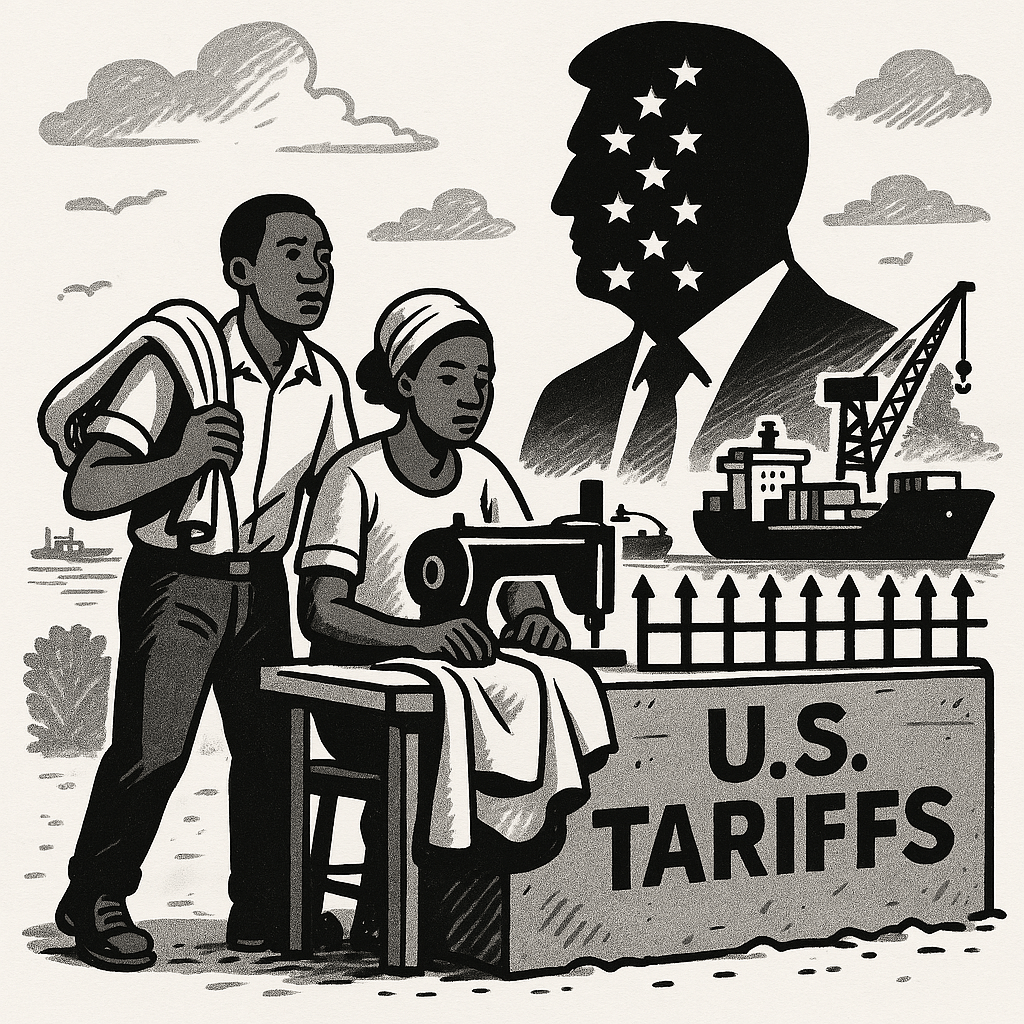
From the shop floors of Lesotho to the bustling ports of Mombasa, one question looms: can Africa’s meagre industrial gains survive the sudden loss of preferential access to the American market?
President Donald Trump’s tariffs have put Africa’s market economies on notice.
Trump’s new tariff formula wallops Africa. All imports to America now face a baseline 10% duty, with “worst offenders”—countries that, in the words of American officials, “treat us badly”—slapped with even steeper levies.
The methodology, which one economist called “idiotic,” penalises nations running large trade surpluses with the US, regardless of size.
Lesotho, which buys next to nothing from America, earned a bruising 50% tariff—the highest of all. Others were not spared: Madagascar 47%, Mauritius 40%, Botswana 37%, oil-rich Angola 32%, and South Africa about 30%. Even countries not singled out—Kenya, Ghana and Ethiopia—must now stomach the flat 10%.
Sew Long, AGOA
The new tariffs—unveiled on what Trump dubbed “Liberation Day”—override the African Growth and Opportunity Act (AGOA)’s preferences and signal that the deal, set to expire in September, is unlikely to be renewed.
For two decades, AGOA was a rare diplomatic bright spot: a trade pact born in the post-Cold War era, meant to spur development not with handouts, but by opening American markets. Passed by the US Congress in 2000, it granted duty-free entry for thousands of African products. It helped turn T-shirts and cars into growth stories. Kenya’s exports under AGOA, mostly textiles, surged from just $55m in 2001 to $603m in 2022. By 2023, African clothing exports to America reached $1.2bn, with more than 96% entering tariff-free.
AGOA’s benefits were uneven. At their peak in 2008, exports under the scheme hit $82bn—fueled largely by oil—before ebbing to $29bn by 2024.
“The reciprocal trade announcement will pull the AGOA rug from under our feet,” warned Adrian Saville, a South African economist, in an interview with Reuters.
The result is the abrupt demise of decades of tariff-free trade. “This latest policy direction is shocking,” fumed Mokhethi Shelile, Lesotho’s trade minister, noting that the US had been “a very important market”—accounting for 45% of the country’s exports. The shock is likely to reverberate across the continent, as a once-generous American initiative ossifies into hard-nosed protectionism.
Threadbare fortunes
Few sectors feel the sting of new US tariffs as sharply as Africa’s apparel industry—AGOA’s most visible success story.
In Lesotho, some 30,000 workers stitch jeans and T-shirts for American brands like Levi’s and Gap. Of these, 12,000 depend directly on US orders. The jobs offer one of the few reliable escapes from poverty. Now, with a 50% tariff looming, that escape route is closing.
“The 50% tariff is going to kill the textile and apparel sector in Lesotho,” warned economist Thabo Qhesi, speaking to Reuters.
Workers echo the fear. “Factory work is the only job I’ve known,” said Makhotso Moeti, who attaches labels in a Maseru facility, in an interview with The Guardian. “If the factories shut down, I’ll be forced to return home to the very poverty I thought I had escaped.” Her monthly pay—around $150—is modest, but it keeps food on the table.
The tariff, aimed at forcing “reciprocal” trade, has little relevance in Lesotho. No Basotho are swapping maize for Missouri corn. Instead, the measure threatens to unravel the one industry that linked the country to global markets.
Lesotho’s crisis is stark, but not unique. Ethiopia, once a darling of global fashion brands, lost AGOA eligibility during its civil war. Foreign investors, including PVH Corp—parent of Calvin Klein and Tommy Hilfiger—fled. More than 11,000 jobs vanished almost overnight.
Kenya, still in Washington’s good graces, exported $737m worth of goods to the US in 2024, over 70% of it apparel. These exports will now face a 10% duty—less severe than the 46% levied on Vietnam, 44% on Sri Lanka, and 37% on Bangladesh.
But Kenya’s manufacturers still face high electricity costs and taxes that leave them 20% less competitive globally. Whatever edge the lower tariff provides may be erased by broader economic headwinds.
The tariffs have rattled markets, and J.P. Morgan now pegs the chance of a global recession this year at 60%. Such a downturn would hurt African exporters indirectly by dragging down demand in Europe and China—their largest trading partners.
Tariff trouble in Pretoria
South Africa, the continent’s industrial heavyweight, has been hit hard by America’s new tariffs. Under Trump’s policy, South African exports face duties of around 30%, while all imported cars and parts are subject to a blanket 25% levy, according to Reuters reporting.
This directly threatens over $2bn in annual auto exports to the US, a sector that had flourished under AGOA.
Trade minister Parks Tau called the tariffs “devastating”, noting that South African vehicles make up less than 1% of American imports. A 25% tariff was already expected to cut GDP growth by up to 0.3 percentage points, according to Al Jazeera; at 30%, the damage could be worse.
Unemployment tops 30%, youth joblessness is even higher. Officials are pushing for a new bilateral deal, but with Trump reviving attacks on South Africa’s land policies, talks look unlikely.
The tariffs extend beyond cars. Exports of aluminium, steel, and platinum—all key inputs in global supply chains—now face higher costs. Citrus growers are also affected. South Africa supplies US supermarkets during America’s off-season, but that hasn’t spared the industry. The Citrus Growers’ Association warns that 35,000 jobs are at risk.
Washington is treating South African goods no differently from those of geopolitical rivals. What AGOA once sheltered, tariffs now expose.
Crude consequences
Africa’s resource-rich economies are also reeling from America’s tariff shift. Nigeria exported $5–6bn worth of goods to the US in 2024, most of it crude oil. Under AGOA, this trade was duty-free. Now, Nigerian goods face tariffs of up to 14%. Trade minister, Dr Jumoke Oduwole, told Punch this would “effectively nullify” the deal’s benefits.
The impact will be sharpest in sectors trying to diversify beyond oil. Cocoa, cashews, leather goods—already low-margin—now face 10–14% US tariffs. Small exporters built around AGOA must absorb higher costs or lose buyers.
While oil may be less affected in the short term—US refiners can simply pay less or buy elsewhere—any revenue dip is painful for a government grappling with deficits, currency volatility, and soaring inflation. One Nigerian analyst warned in Al Jazeera that rising export costs risk “destabilising economies” already in crisis.
Abuja has opened talks with Washington and the World Trade Organisation, seeking what officials call “mutually beneficial” solutions. But with Trump in protectionist mode, the prospects for concessions look slim.
Ghana faces a 10% tariff—less severe, but still eroding AGOA’s value. Its modest exports to the US—cocoa products, fruits, a fledgling garment sector—are now less competitive.
With Washington pulling back, Accra is looking inward. Ghana’s foreign minister, Samuel Ablakwa, used a recent visit to Nigeria to call for removing trade barriers within West Africa. Intra-African trade accounts for less than 20% of total commerce, compared with 60% in Europe. Officials hope the African Continental Free Trade Area (AfCFTA) might redirect goods away from American ports and into regional markets.
Still, replacing the world’s largest consumer market with one’s poorer neighbours is easier said than done. West African economies are themselves struggling, and infrastructure gaps make intra-African commerce costly.
A Ghanaian cocoa exporter losing a US buyer cannot easily redirect shipments to Burkina Faso. A garment factory facing cancelled orders will struggle to replace them with regional contracts. Integration may help in the long run—but for now, the trade shock bites.
Pivoting to Beijing
As Washington retreats, Beijing advances. China has long been Africa’s top trading partner, far ahead of the United States. It buys oil, copper, and cocoa; it sells back phones, buses, and T-shirts. Trump’s tariffs may accelerate this drift to the east.
African officials, frustrated by America’s abrupt turn, are looking for steadier partners. China’s role is already entrenched, from railway loans in Kenya to industrial parks in Ethiopia.
But China’s interest has never been altruistic. The trade pattern—Africa exports raw materials, imports finished goods—resembles old colonial structures. The risk is that turning east replaces one dependency with another.
Still, some officials see little alternative. “We will increase efforts to export to alternative markets such as the EU and the African Free Continental Trade Area,” Lesotho’s trade minister told The East African, pointedly omitting the US. Others quietly add China to the list. Unlike AGOA, China has invested in local value chains—albeit with Chinese labour and capital.
After Trump’s announcement, Chinese officials quickly reminded African partners of ongoing trade talks—a contrast to Washington’s new tariffs. Beijing’s “win-win” language may not be entirely convincing, but the message is clear: when the US closes doors, China opens them.
After AGOA
The end of AGOA’s tariff-free access marks a turning point.
Across Africa, officials and entrepreneurs are weighing next steps. The most immediate concern is jobs. One analysis warned the tariffs could trigger factory closures and mass unemployment, especially in Lesotho and Madagascar.
AGOA was meant to spur industrialisation. It encouraged firms to move beyond raw exports—setting up garment plants in Ethiopia, handbag factories in Nigeria. Now, investors may pause. “It’s unclear whether brands will rush to shift operations to Africa just for a temporary tariff edge,” a Kenyan apparel executive told Reuters.
Some see a wake-up call. “When we come together and bring down artificial borders… it cannot separate us,” Ghana’s foreign minister told This Day, urging greater intra-African trade.
Others argue Africa must now become competitive on its own—through better infrastructure, power, and governance—rather than relying on US trade breaks.
That challenge is real. Without AGOA, the gap between promise and performance grows wider. “Grand initiatives come and go,” one US official told African Business, “but real people live with the consequences.”
Efforts to salvage the deal are under way. Lesotho and South Africa have sent delegations to Washington to request relief or delays. Some diplomats hope Congress, not the White House, may yet temper the tariff policy—especially ahead of a planned US-Africa summit later this year.
On the ground, businesses are adjusting. A Nairobi garment exporter is deciding whether to cut jobs or absorb costs. Johannesburg suppliers are shifting focus to Europe. Agro-processors in West Africa worry US buyers will pivot to Latin America or Asia.
Africa’s big economies now enter an uncertain phase. The end of AGOA’s preferences may spur regional trade and global diversification. But it also threatens to unwind hard-won gains.
Trump’s tariffs are a wake-up call to African leaders. They must now weave new trade patterns—without a benevolent superpower holding the yarn.
This article’s illustration was generated using ChatGPT, an artificial-intelligence tool by OpenAI.
 Wayfarer