
In the Quran, when God creates man and sets him as custodian upon the earth, the angels, observing from the heavens, protest. “Will you place in there someone who will sow corruption and shed blood?” they ask. God teaches Adam the names of things, a knowledge the angels do not possess.
The American writer Ta-Nehisi Coates’s new book, The Message, tackles this theme—man’s corruption of the earth, and language as reckoning.
And in a grand gesture, Coates calls for nothing short of the world’s salvation. The book, which has garnered a critical reception for its chiding of Israel, is written as a letter addressed to his students at Howard University, where Coates teaches. It follows a tradition—the epistles of the enslaved, Alice Walker’s The Colour Purple, James Balwin’s The Fire Next Time, the sermons of priests, the rhymes of rappers.
African American culture, rooted in the oral, has retained the rhythms and cadences of speech, sharpened over centuries by the songs of exile. And with this orality comes an idealism, a wish to lay bare the truth, to give voice to the voiceless.
Coates’s predecessors are giants: Frederick Douglass, whose words captured the horrors of slavery; Malcolm X, whose voice gave the civil rights movement its poetry; Baldwin, who wrote of America from below. Coates, born after the movement in a world his predecessors could only imagine, is acutely aware of this.
Uprooted and held in bondage, African Americans turned their past into myth, seeking dignity in invention. In servitude, they dreamt of lost kingdoms. Coates’s own name reaching back to Egypt is an example of this. And as the exile deepened, the dream of return took hold—not to Africa but to the idea of Africa. The Mighty Race. The Redemption Song. Marcus Garvey’s Eden. Martin Delaney’s Black nationalism.
Even the book’s title is layered. It evokes The Messenger, a magazine that heralded the Harlem Renaissance, and The Message, a song by Grandmaster Flash and the Furious Five, which gave hip-hop its conscience. So Coates’s book is both a sermon and a lament.
From the reviews, I assumed the book was all about Israel. In fact, it consists of three essays, all journeys: one to Senegal, the second to South Carolina, the third to Palestine. Unlike his earlier work, this is set abroad. For the first time, Coates writes about others, tracing America’s impact on the wider world. It is a personal reckoning with history, the reflections of a middle-aged man seeking to find his place in the world and heal.
Out of Africa
Coates’s first journey, meant to mimic the one his ancestors imagined, lands him in Senegal. He stands on a beach and imagines the past—sees the ghosts of his forebears, suffocating in the hulls of ships. But there is no royalty here, no empire. The Senegalese are Black, and this must mean something. But in Coates’s eyes, they are trapped in the shadow of colonialism, struggling to survive. The beach is strewn with litter, which stirs unease about his heritage. “I was still afraid the Niggerologists were right about us,” Coates writes. He has been so inundated with stories of Black inferiority that he struggles to see these people as they are.
Yet Coates is an American pilgrim, an anomaly. The returning son finds himself the master. The Africans have consumed the stories of African Americans—stories of those who ascended to wealth and power—and they aspire to the same. But Coates, unaccustomed to power, assumes this is about colour. In America, power is bound to colour. In Senegal, he writes, “Black Americans are seen as cool, glamorous, and even beautiful because we are mixed.” The African, scarred by colonialism, looks up to the Black American, who is mixed, closer to white, and, in the imagination, more powerful.
Coates knows he is acting out a myth: “I was a pilgrim on an ancestral journey, back to the beginning of time, not just to my own birth but to the birth of the modern world.” The modern world, to him, is America, built on bondage. He has travelled 500 years back in time. This is the Africa of the exile.
On Gorée Island, where African Americans make their pilgrimage, Coates is overwhelmed. He knows that for the Senegalese, this is simply home, carrying only the weight of daily life. “I was a man who insists on walking the rooms of his childhood home to commune with ghosts, heedless of the people making their home there now,” he writes. Coates tries to see the Senegalese as people, but he cannot. He is a pilgrim, trapped in the past, held captive by ghosts. No amount of reasoning can override the raw emotion of the Black man’s return to Africa—the fulfilment of a centuries-old dream.
Native in name alone
Coates’s second journey takes him to South Carolina where he is invited by Mary Wood, an English teacher. This visit is a reckoning, a report on the current state of the African American experience.
The Black American has been granted citizenship, but it remains tenuous. The contest in America is now over identity, over what the nation stands for.
Coates and his peers, among them Nikole Hannah-Jones of 1619 fame, place slavery at the centre of America’s story. Others, equally American, consider such a history best left buried.
For those whose ancestors knew bondage, this erasure is a personal affront. They demand an accounting and argue the nation, to be whole, must acknowledge its past. But to some, this reckoning is an intrusion, an insult. They will not accept it. And so the battle lines are drawn, each side retreating into its own version of America.
Coates, faced with the rejection of his history, sides with those who at least acknowledge it. He condemns the others as white supremacists. But they have their own storytellers, seeking a new narrative, a lost cause. And so America, born of contradiction, continues in contradiction: each side righteous in its own telling, each believing itself the hero. They silence each other, burn each other’s books.
The so-called white supremacists have their martyrs: Woodrow Wilson, who screened The Birth of a Nation at the White House; Donald Trump, who rose to power on the grievance of those who feel they’ve lost their country. The Black Americans and their allies also have their own: Obama, whom they consider a flicker of light. Coates, at his worst, engages in this cultural war, defending safe spaces, embracing flatterers, refusing to see beyond his grief. This, the weakest part of his book, reveals his limitation. I wish he could rise above the war itself, but he is bound by history, by the weight of his story. He cannot transcend it.
No mercy in the Promised Land
Coates finds his voice again in Palestine and the West Bank. What strikes him most is Israel’s hypocrisy. To the West, it is the Middle East’s democracy; at home, it practises apartheid. The evidence is everywhere: the endless checkpoints, segregation, roads marked by number plates distinguishing Israeli from Palestinian.
Like Coates’s ancestors, the Jews have known exile and conjured Eden in their longing. But Jewish exile was different. It gave birth to the world’s great religions, all claiming Jerusalem. With Christian America’s help, the Jews did not just return; they built a state—modern, efficient, made possible by the theft of Palestinian land. Here, power is in faith, not skin.
For Coates, Israel is a mirror of America, its story a re-enactment of his own past. In its legal barriers, in its dispossession of a people, he sees the ghost of Jim Crow. The poll tax, which priced Black voters out of democracy; redlining, which locked Black families out of homeownership; the Grandfather Clause, which barred Black citizens from voting by tying eligibility to ancestry. “I felt my deep ignorance about the world beyond America’s borders, and with that, a deep shame,” he writes.
Yet Israel, like America, tells a heroic story. Coates believes this is what might have happened if Black Americans had returned to Africa and built a colony. And like all stories of conquest, this one is built on myths. Israel, like America, has enshrined its myths, layering them over a harsher reality, where Palestinians gasp for air.
America had cleared its land of Indigenous people; Israel had conquered the Palestinians. This is the foundation of their friendship. From each conquest arises a heroism, a people filled with pride, certain of their superiority over those beneath their boots.
Coates moves through the Holy Land as a pilgrim, but without scripture, without myth. He sees a people who have suffered and, in power, learnt only to inflict suffering. And another, still suffering. There is no justice here, no mercy—only the cold machinery of subjugation. “A system of supremacy justifies itself through illusion, so that those moments when illusion can no longer hold always come as a great shock,” he writes.
A writer reborn
In this book, Coates strips Israel of its illusions. The Palestinians, like his own people, cling to the dream of return, their subjugation funded by America. “This was not merely another evil committed by another state, but an evil done in my name,” he writes.
His pilgrimage is not only a search for himself but for his ancestors, and in the Palestinians, held in bondage, he finds them. Like his forebears, the Palestinians console themselves with the delusions of exile. Their histories align: the expulsion, the second-class citizenship, the segregation, the fantasy of return, the cold machinery of the state, the insistence on myths. It is as if Coates has stepped into the past and met his ancestors.
But why had he not seen this before? Coates is angry, righteous, and his writing suffers for it. At times, he strikes the wrong blows. He blames not himself but his editors at The Atlantic, whose only fault is their whiteness. Yet abroad, Coates finds there is nowhere else for him to go—no illusions left to shelter him. He is American, inescapably, whatever that may mean. And as a citizen, he bears the burden of his country’s actions.
In his earlier work, Coates chronicled what America had done to him. Now, he examines what America has done to others. To do so, he abandons journalistic detachment and picks a side. At times, he recoils from this burden, wishing the Palestinians could tell their own story. Yet Coates knows he is uniquely placed to document his country’s deeds. The son has accepted the sins of the father and can now live on his own terms. One thing is certain: Coates is true to his sermon.
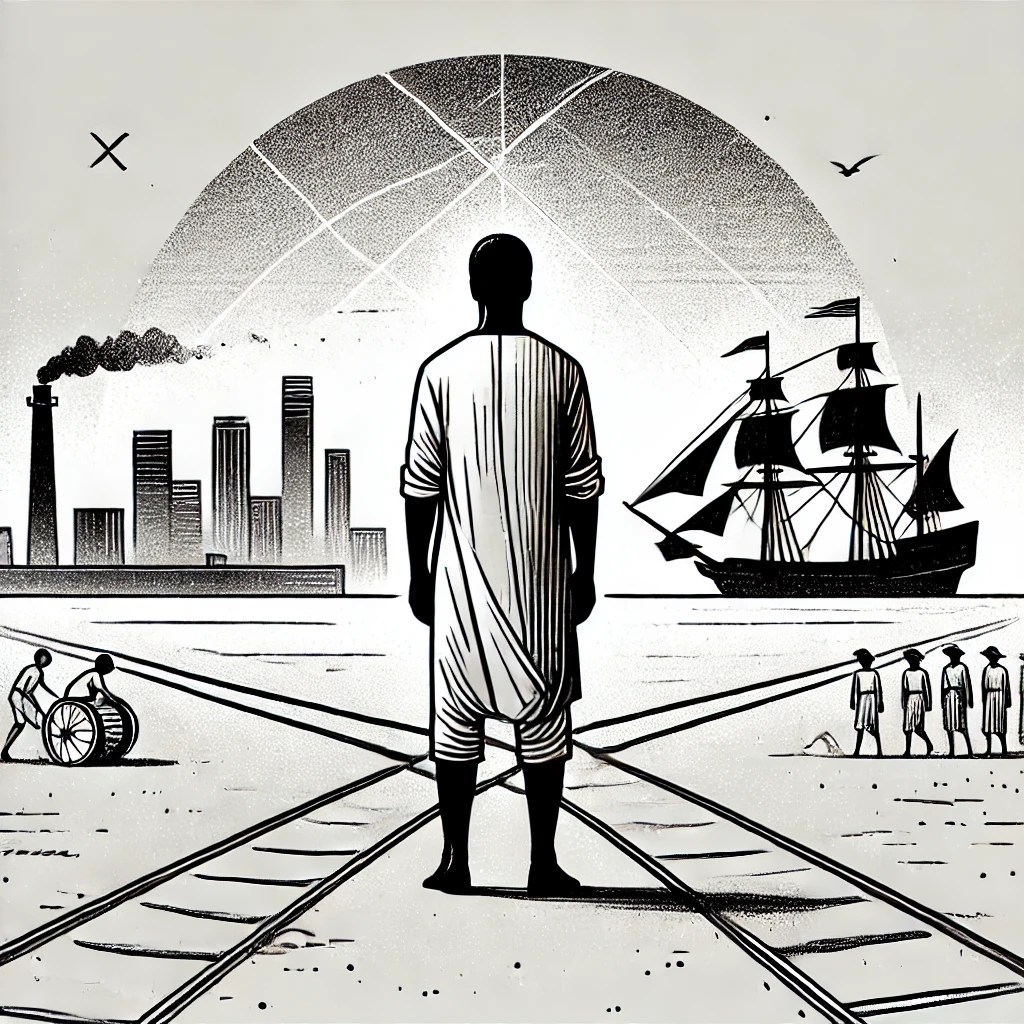
This article’s illustration was generated using ChatGPT, an artificial-intelligence tool by OpenAI.
 Wayfarer