
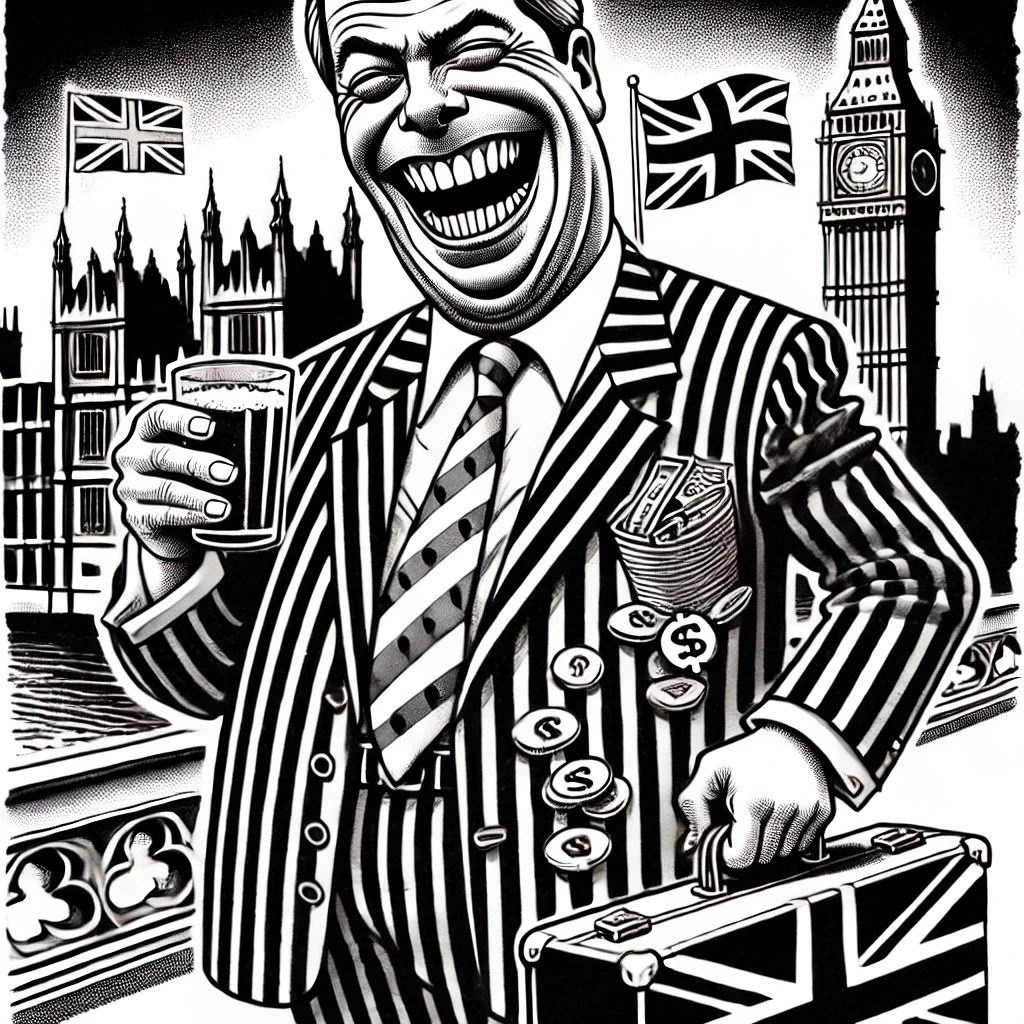
Nigel Farage, metals trader by profession, schoolboy by temperament, is above all a grifter—out for himself, yet adept at convincing others he is on their side.
Since entering Parliament, the member of parliament for Clacton has scarcely set foot in his constituency. He has been elsewhere, travelling the world—especially America, where he attended Trump’s inauguration. For three decades, he fought to get into Westminster, standing for election seven times before securing victory on his eighth attempt. But he has little use for the dull obligations of governance. According to The Guardian, he has not opened an office in his constituency, nor held surgeries in his first few months. He is more at home in front of a camera. A show he hosts on GB News earns him £1,175,140.80 a year, far more than his parliamentary salary of only £91,346. He also sells personalised videos on Cameo and attends conferences, especially those that pay well.
But his party, Reform UK, is ascendant. A poll by The Spectator put it at 25 percent, ahead of both Labour (24 percent), which won handily in the 2024 general elections, and the Conservatives (22 percent), still adrift from their worst defeat in history. But more than the numbers, it is Farage’s message—his hard line on immigration—that has taken hold. Even Prime Minister Keir Starmer’s Labour has begun to follow his lead, broadcasting videos of Trump-style deportations and blocking asylum seekers who cross the English Channel by boat from acquiring citizenship in an attempt to appear tough. This is the measure of Reform’s success.
The party’s platform is familiar—a blend of low-tax libertarianism and culture war grievances, railing against “woke ideology,” climate policies, and illegal migration. Farage and his allies present Reform UK as the only true alternative, claiming that both the Conservatives and Labour have betrayed ordinary Britons. The party has tapped into a deep, lingering frustration: the cost of net zero policies, rising energy bills, the government’s failure to stop small boats crossing the Channel.
Farage’s populism—crude, relentless, offering simple solutions to complex problems—remains intact. The slogans are blunt, designed to cut into the mainstream media: “Scrap net zero,” “Slash taxes,” “Stop the boats.” It is a message that lands well with those who feel ignored by Westminster. But if the rhetoric is effective, the policies remain vague, the economics uncertain. Farage has never had to govern. And critics argue that, like UKIP before it, Reform UK is not a party of power but of pressure—a movement designed to shift the debate, rather than to lead.
And it is working. On TikTok, Reform UK has drawn in a new generation—disgruntled young men who know nothing of Farage’s past, who encountered him only after he reinvented himself. “I don’t understand words,” Farage once admitted. He has never been accused of being a writer. But he speaks well, and in politics, that is enough. He has, however, been called a racist—for as long as anyone can remember.
Finding an enemy early
Farage’s life has been nothing if not contentious. And he started early. In One Party After Another, Michael Crick, his biographer, recounts an anecdote that captures the pattern of his life. As a student at Dulwich College, he was made head boy amid controversy. Once secure in his new role, Farage at once turned against his fellow students. “Sir,” he told the schoolmaster, “there is a growing problem with indiscipline within the school. We should use the cane more.” It was an instinct that would define him. Years later, Farage would apply the same principle to his country, only on a far grander scale.
As a boy, Farage was amused by the coincidence of his initials matching those of the National Front, the neo-fascist party, and he scrawled NF wherever he could. It was, in fact, one of the reasons his teachers hesitated to make him a prefect. He came of age in a Britain uneasy with itself—Thatcherism had taken hold, industry was collapsing, unemployment was rising, and social unrest was spreading.
His hero was, inevitably, Enoch Powell, who spoke at Dulwich in Farage’s final year. Powell’s Rivers of Blood speech cast Britain’s immigrants—most from former colonies—as an enemy within, a threat to the country’s very character. Farage, captivated by the message, never outgrew that early fascination. Even now, long past boyhood, he is still railing against immigrants.
“Rules for them, freedom for me”
After graduation, Farage moved to London with the prospect of making a fortune and threw himself into a life of drinking and indulgence—an extension of his adolescence. Though always a Eurosceptic, Farage joined the European Parliament, claiming he would change it from within. The salary was the same as that of an MP—£47,008 in 1999—but the real appeal lay elsewhere: a generous staff budget, untaxed allowances, and expenses that required no justification.
Farage railed against this. He promised to use the excess funds to establish a trust for the “victims of the European Union in our own country.” By Michael Crick’s calculations, if he attended Parliament four days a week, his allowances alone would have amounted to £135,000. But nothing came of the promise.
In the end, Farage did what he has always done. He called for discipline while exempting himself. He dined at fine restaurants, travelled on the Eurostar, and skipped meetings. Yet he continued to present himself as a warrior against the European Parliament, even as he used its funds to staff his own UKIP party, in open defiance of the rules.
The European Parliament was a club of the well-connected. Its members included Nicolas Sarkozy, the future President of France; Mario Soares, the former President of Portugal; Ian Paisley, the Northern Irish firebrand; Jean-Christophe and Charles de Gaulle Jr., grandsons of the wartime leader; and Alessandra Mussolini, granddaughter of the dictator. Farage, for all his railing against the institution, belonged there. He flourished within the system, drew from its excesses, and lived off the very corruption he condemned. Yet he spoke as if he were untouched by it, as if he were waging a lonely battle on behalf of the people.
Trickster of Britain
Farage’s appeal lies in his performance of authenticity. He has never been an ordinary man—he was schooled at Dulwich, trained as a broker, and moved easily in the world of money. But he understood how to wear ordinariness like a costume, how to adopt the grievances of those left behind by history.
Throughout the late 2000s, Farage built UKIP’s profile through spectacle—media stunts, provocative statements, a carefully cultivated image. He styled himself as an everyman, always with a pint in hand, a cigarette dangling from his fingers.
Farage “said things mainstream politicians simply can’t,” under the banners of “common sense” and “straight talking” that allowed him to speak for the disenfranchised ‘real people.’ Those who felt abandoned by Westminster saw in him a man who understood their grievances. And the media, ever drawn to controversy, gave him the attention he sought.
Under Farage, UKIP ceased to be a fringe outfit and became something larger—a vehicle for protest. He understood what others did not: that beneath the surface, there was resentment, a sense of betrayal, an anger that could be harnessed. In 2014, UKIP won the European elections, defeating both Labour and the Conservatives. It was not a victory of power—UKIP controlled nothing—but of recognition.
David Cameron, the Prime Minister, dismissed UKIP as a party of “fruitcakes, loonies, and closet racists.” But even he understood the threat. He had to make a concession. It was, in the end, a victory for Farage.
A win without winning
Brexit was Farage’s triumph. The 2016 referendum was the culmination of years of agitation, of speeches that made politicians shift uneasily and filled the newspapers with outrage. His infamous Breaking Point poster—a photograph of a long queue of non-white migrants—was condemned as racist. But it had served its purpose. It fixed immigration as the central issue of the referendum, reducing a complex debate to a single, visceral image.
His message was blunt: take back control. It was not about policy, not about facts, but about feeling—about grievance, about nostalgia for a country that never quite existed. He was not part of the official Leave campaign, but he did not need to be. His was the language of the streets, of resentment, of defiance. The morning after the vote, Farage stood before the cameras, exultant. “Our independence day,” he declared, before taunting the European Union: “You’re not laughing now.” It was a victory the Westminster establishment never wanted, and he revelled in it.
Weeks later, in July 2016, he stepped down as UKIP leader, claiming his lifelong mission was complete. Without him, the party unraveled. UKIP fell into internal feuds, its influence fading as quickly as it has risen. The task of delivering Brexit fell to the Conservatives. From the sidelines, Farage remained a presence, warning Theresa May against a “soft Brexit,” threatening to return if the result was “betrayed.” And when Brexit stalled—mired in delays and uncertainty—he did exactly that.
Yet for all his influence, Farage remains on the fringes. He is in Westminster now, and Reform is no longer a fringe movement, but he still carries himself as an outsider. He is not a man of governance; he is a man of disruption. His legacy is not a party, not a programme, but a mood—a deep, abiding distrust of institutions, a sense that the political class and the people are forever divided. He does not ask for reform but for upheaval. He wants to dismantle the first-past-the-post system—the only way his party could ever win a general election.
Though Farage’s party is leading the polls, Starmer is also doing well. Since Trump’s rebuke of Zelensky in the Oval Office on February 28, Europe has closed ranks around him. And, inevitably, Farage takes credit. He claims that Starmer can only do this because Britain is no longer bound by the European Union. Yet with the United States retreating from Europe, Britain can no longer afford to be an island. It must work with Europe. But how can it, when it is no longer part of the EU?
In retrospect, Farage’s nationalism appears less of a strength and more like a liability. Britain cannot defend itself alone. Yet if Labour fails to deliver, and the Conservatives remain lost, there may be enough discontent in the country to lift him once more. And that discontent, that sense of grievance, may one day carry him to No. 10.
This article’s illustration was generated using ChatGPT, an artificial-intelligence tool by OpenAI.
 Wayfarer